I’ve been getting complaints that my lemmas have not been so lovely (or little) lately, so let’s do something a bit more down to earth. This is a story I learned from the book Counterexamples in topology by Steen and Seebach [SS].
A topological space  comes equipped with various operations on its power set
  . For instance, there are the maps
  (interior),
  (closure), and
  (complement). These interact with each other in nontrivial ways; for instance
  .
.
Consider the monoid  generated by the symbols
  (interior),
  (closure), and
  (complement), where two words in , , and are identified if they induce the same action on subsets of an arbitrary topological space .
Lemma. The monoid has 14 elements, and is the monoid given by generators and relations
![\[M = \left\langle a,b,c\ \left|\ \begin{array}{cc} a^2=a, & (ab)^2=ab, \\ c^2=1, & cac=b.\end{array}\right.\right\rangle.\]](https://lovelylittlelemmas.rjprojects.net/wp-content/ql-cache/quicklatex.com-107e423b90c7869e548d1339c52c74c2_l3.svg "Rendered by QuickLaTeX.com")
Proof. The relations  ,
,  , and
, and  are clear, and conjugating the first by shows that
  is already implied by these. Note also that and are monotone, and
  for all
  . A straightforward induction shows that if
  and
and  are words in and , then
  . We conclude that
![\[abab(S) \subseteq abb(S) = ab(S) = aab(S) \subseteq abab(S),\]](https://lovelylittlelemmas.rjprojects.net/wp-content/ql-cache/quicklatex.com-cef37cdb9f5ca64ad8b8a2d5965ff8b7_l3.svg "Rendered by QuickLaTeX.com")
so  (this is the well-known fact that
  is a regular open set). Conjugating by also gives the relation
  (saying that
  is a regular closed set).
Thus, in any reduced word in , no two consecutive letters agree because of the relations  , , and . Moreover, we may assume all occurrences of are at the start of the word, using
  and
and  . In particular, there is at most one in the word, and removing that if necessary gives a word containing only and . But reduced words in and have length at most 3, as the letters have to alternate and no string
  or
or  can occur. We conclude that is covered by the 14 elements
![\[\begin{array}{ccccccc}1, & a, & b, & ab, & ba, & aba, & bab,\\c, & ca, & cb, & cab, & cba, & caba, & cbab. \end{array}\]](https://lovelylittlelemmas.rjprojects.net/wp-content/ql-cache/quicklatex.com-ac64f82945759d486e7f3d9cadc4eb2a_l3.svg "Rendered by QuickLaTeX.com")
To show that all 14 differ, one has to construct, for any  in the list above, a set
  in some topological space
  such that
  . In fact we will construct a single set
  in some topological space where all 14 sets
  differ.
Call the sets for  the noncomplementary sets obtained from
  , and their complements the complementary sets. By the arguments above, the noncomplementary sets always satisfy the following inclusions:
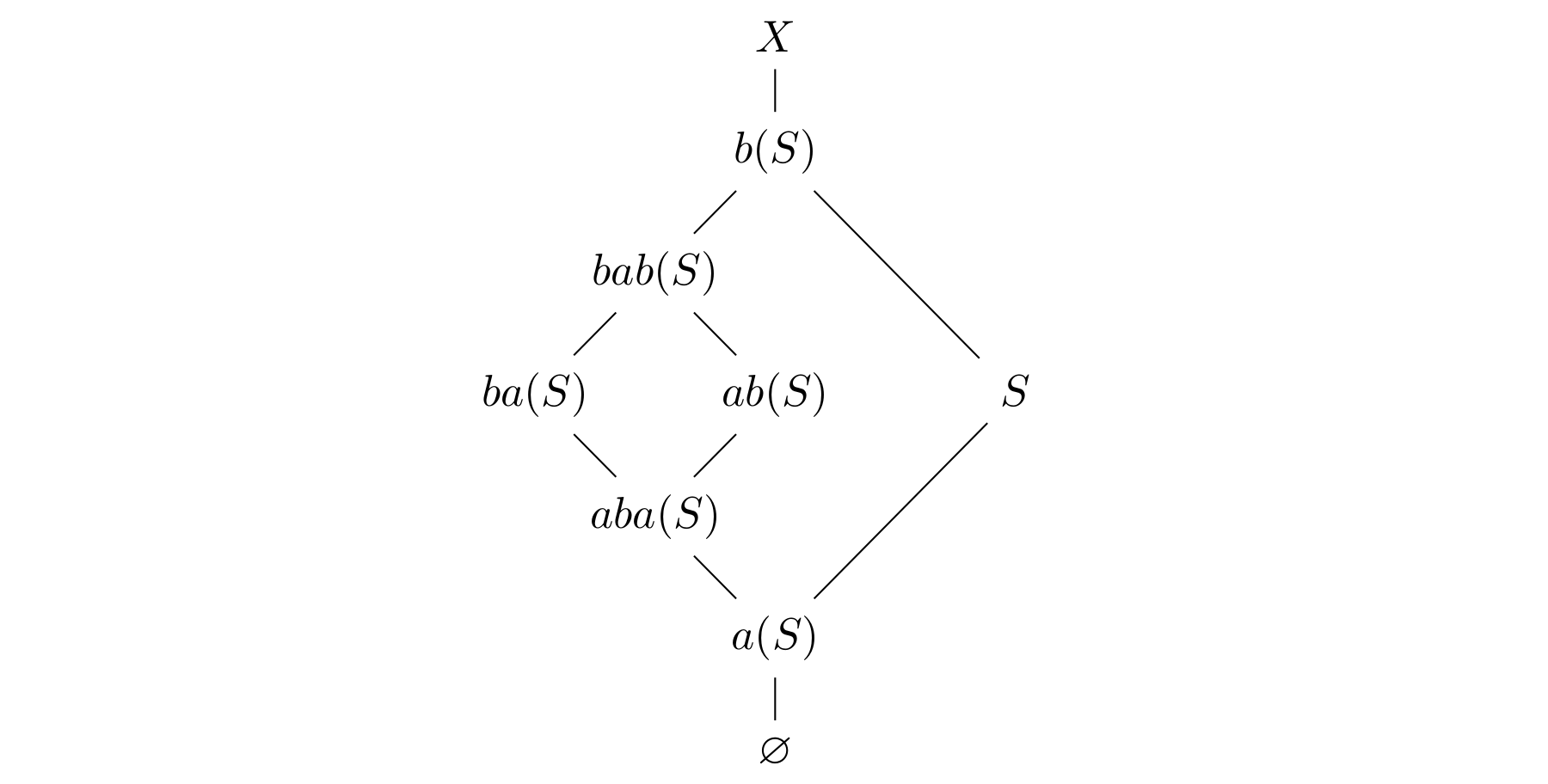 It suffices to show that the noncomplementary sets are pairwise distinct: this forces
  (otherwise
  ), so each noncomplementary set contains
  and therefore cannot agree with a complementary set.
For our counterexample, consider the 5 element poset  given by
![\[\begin{array}{ccccc}p\!\!\! & & & & \!\!\!q \\ \uparrow\!\!\! & & & & \!\!\!\uparrow \\ r\!\!\! & & & & \!\!\!s \\ & \!\!\!\nwarrow\!\!\! & & \!\!\!\nearrow\!\!\! & \\ & & \!\!\!t,\!\!\!\!\! & & \end{array}\]](https://lovelylittlelemmas.rjprojects.net/wp-content/ql-cache/quicklatex.com-fd07751615877f22d5bd099f23612bc4_l3.svg "Rendered by QuickLaTeX.com")
and let be the disjoint union of  (the Alexandroff topology on , see the previous post) with a two-point indiscrete space
  . Recall that the open sets in are the upwards closed ones and the closed sets the downward closed ones. Let
  . Then the diagram of inclusions becomes
 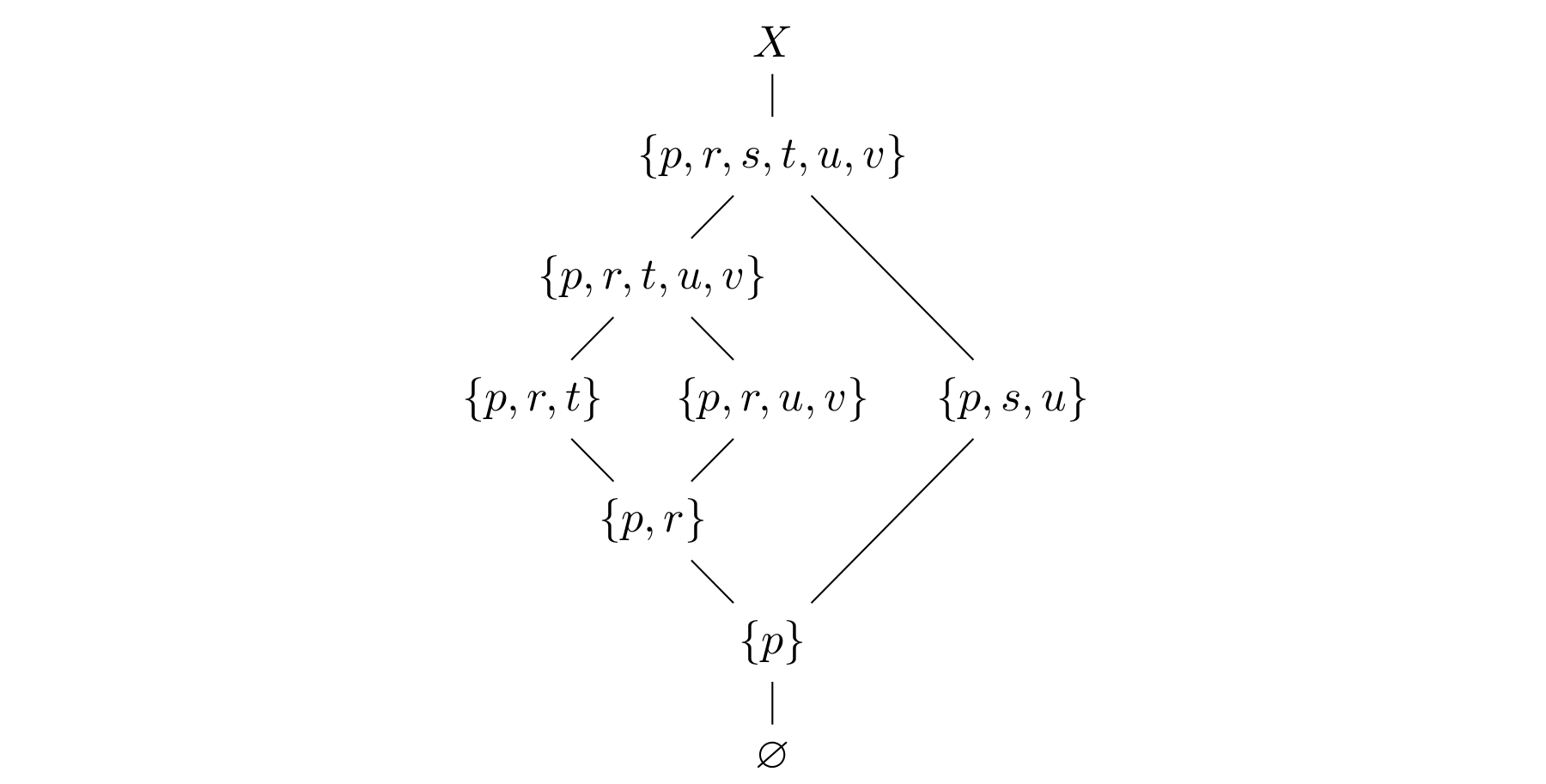 We see that all 7 noncomplementary sets defined by are pairwise distinct.
Remark. Steen and Seebach [SS, Example 32(9)] give a different example where all 14 differ, namely a suitable subset  . That is probably a more familiar type of example than the one I gave above.
On the other hand, my example is minimal: the diagram of inclusions above shows that for all inclusions to be strict, the space needs at least 6 points. We claim that 6 is not possible either:
Lemma. Let be a finite  topological space, and any subset. Then
  and
and  .
.
But in a 6-element counterexample , the diagram of inclusions shows that any point occurs as the difference  for some
  . Since each of and
  is either open or closed, we see that the naive constructible topology on is discrete, so is by the remark from the previous post. So our lemma shows that cannot be a counterexample.
Proof of Lemma. We will show that  ; the reverse implication was already shown, and the result for
  follows by replacing with its complement.
In the previous post, we saw that is the Alexandroff topology on some finite poset  . If is any nonempty subset, it contains a maximal element
  , and since is a poset this means
  for all
  . (In a preorder, you would only get
  .)
.)
The closure of a subset is the lower set  , and the interior is the upper set
  . So we need to show that if
  and
and  , then
  .
.
By definition of , we get  , i.e. there exists
  with
with  . Choose a maximal
  with this property; then we claim that is a maximal element in . Indeed, if
  , then
  so
so  , meaning that there exists
  with
with  . Then
  and , which by definition of means
  . Thus is maximal in , hence
  since and
  . From we conclude that , finishing the proof.
The lemma fails for non- spaces, as we saw in the example above. More succinctly, if  is indiscrete and
  , then
  and
and  . The problem is that
  is maximal, but
  and
and  .
.
References.
[SS] L.A. Steen, J.A. Seebach, Counterexamples in Topology. Reprint of the second (1978) edition. Dover Publications, Inc., Mineola, NY, 1995.
 be a field and
  a nilpotent matrix. Then
  .
.![\[0 \subseteq \ker M \subseteq \ker M^2 \subseteq \ldots \subseteq \ker M^n = k^n\]](https://lovelylittlelemmas.rjprojects.net/wp-content/ql-cache/quicklatex.com-51a6e62b4ed1d907dc4e6f7327f2c042_l3.svg "Rendered by QuickLaTeX.com")
 be a commutative ring with nilradical
  , and let
  satisfies
![\[p_M(t) \in t^n + \mathfrak r[t]_{< n}.\]](https://lovelylittlelemmas.rjprojects.net/wp-content/ql-cache/quicklatex.com-4e4ce3a23d59332534d9b28b2f8d5eab_l3.svg "Rendered by QuickLaTeX.com")
![I[t]_{<n} \subseteq R](https://lovelylittlelemmas.rjprojects.net/wp-content/ql-cache/quicklatex.com-118fff28ce7ec19c5984414e565306ce_l3.svg "Rendered by QuickLaTeX.com") for the polynomials in
for the polynomials in  whose coefficients lie in a given ideal
  .
.![R[t]^\times = R^\times + t\mathfrak r[t]](https://lovelylittlelemmas.rjprojects.net/wp-content/ql-cache/quicklatex.com-7a86c0cd39c7f8b6e542c5b43e2bc397_l3.svg "Rendered by QuickLaTeX.com") . When
. When ![R[t]^\times = R^\times](https://lovelylittlelemmas.rjprojects.net/wp-content/ql-cache/quicklatex.com-8b7a0fb422d208f4c84758fac16be6e5_l3.svg "Rendered by QuickLaTeX.com") , and the lemma just says that
, and the lemma just says that  .
. but with its anadrome (or reciprocal)
  .
.![\det(I-tM) \in 1 + t\mathfrak r[t]](https://lovelylittlelemmas.rjprojects.net/wp-content/ql-cache/quicklatex.com-67a10c9d1c94f6e6c01cd366d19e7cdf_l3.svg "Rendered by QuickLaTeX.com") . Since
. Since  with
with  , so
, so  . Thus
 ![\det(I-tM) \in R[t]^\times = R^\times + t\mathfrak r[t]](https://lovelylittlelemmas.rjprojects.net/wp-content/ql-cache/quicklatex.com-589db4c59eb8b107600b4e0f9026d9a0_l3.svg "Rendered by QuickLaTeX.com") . Evaluating at
. Evaluating at  shows that the constant coefficient is 1.
 ![a_nt^n + \ldots + a_1t + a_0 \in R[t]](https://lovelylittlelemmas.rjprojects.net/wp-content/ql-cache/quicklatex.com-f627421e1a43ec154521958d1ad61dcf_l3.svg "Rendered by QuickLaTeX.com") is invertible if and only if
is invertible if and only if  is invertible and
  are nilpotent. This is the formulation you find in Atiyah–MacDonald, exercise 1.2(i). Note that when
  with
with  and
and  . Multiplying by
  we may assume
  ; this does not change the nilpotence assumption on
  is nilpotent since it is a sum of nilpotent elements
  in the commutative ring
 ![R[t]](https://lovelylittlelemmas.rjprojects.net/wp-content/ql-cache/quicklatex.com-f7a95fbe006fee2f1c5d791316639263_l3.svg "Rendered by QuickLaTeX.com") . Thus we get
. Thus we get  for some
 ![\[(1-g)(1+g+\ldots+g^r) = 1\]](https://lovelylittlelemmas.rjprojects.net/wp-content/ql-cache/quicklatex.com-c10b13e97e7f64053d59718b326378cc_l3.svg "Rendered by QuickLaTeX.com")
![f \in R[t]^\times](https://lovelylittlelemmas.rjprojects.net/wp-content/ql-cache/quicklatex.com-c6226052fa97c27ed2e08c58cd9af688_l3.svg "Rendered by QuickLaTeX.com") . Conversely, let
. Conversely, let  for some polynomial
 ![g = b_mt^m + \ldots + b_1t+b_0 \in R[t]](https://lovelylittlelemmas.rjprojects.net/wp-content/ql-cache/quicklatex.com-72c492a99a9dbd66015d402271b2f5b8_l3.svg "Rendered by QuickLaTeX.com") . Without loss of generality we may assume
. Without loss of generality we may assume  . If
. If  is
is  , so we must have
  and
and  and
and  are constant. In the general case, we conclude that
 ![\phi(f) \in S^\times \subseteq S[t]](https://lovelylittlelemmas.rjprojects.net/wp-content/ql-cache/quicklatex.com-b441ca0dd558c5076fbb21dc6cb54826_l3.svg "Rendered by QuickLaTeX.com") for any ring homomorphism
for any ring homomorphism  to a domain
  for any prime ideal
  shows
shows  and
and  . Taking the intersection over all prime ideals gives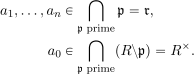
 if and only if
  .
. , and if
  , then
  , so
, so  , showing
  . We denote this preorder by
  .
. in algebraic geometry, which is pronounced “
 specialises to
  are the cosieves, i.e. the upwards closed sets (meaning
  and
and  ).
). for any
  . We denote the set
  .
. . The closure of
 is the principal sieve
  .
. be the functor
  , and
, and  the functor
  .
. a topological space, and
  a function. Then
  if and only if
  .
. and
and  are adjoint:
  .
. is equal (not just isomorphic!) to the identity functor.
 to the category
  of finite topological spaces is equal to the identity functor.
 is a poset.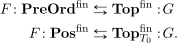
 is monotone, let
  be a closed subset, and let
  . Suppose
  and
and  . Since
  is closed, we get
  , i.e.
  . We conclude that
  , so
, so  is downward closed, hence closed in
  is continuous, and suppose
  , so by continuity we get
  , so
, so 
 , we conclude that
  if and only if
  , so the specialisation preorder on
  is a continuous map on the same underlying space, so
  is finer than
  is closed, i.e.
  , then
  ; in other words
  . If
. If ![\[Z = \bigcup_{y \in Z} \overline{\{y\}}\]](https://lovelylittlelemmas.rjprojects.net/wp-content/ql-cache/quicklatex.com-11d61c63dc4e154f200b78331170bfc7_l3.svg "Rendered by QuickLaTeX.com")
 , and a
  since
since  by (3).
 follows from (3) and (4), and the equivalence
  then follows from (5) and (6).
 ![[1] = \{0 \leq 1\}](https://lovelylittlelemmas.rjprojects.net/wp-content/ql-cache/quicklatex.com-fe0d56d5d60a51deeea514537789ad89_l3.svg "Rendered by QuickLaTeX.com") is the Sierpiński space
is the Sierpiński space  with topology
  . As explained in
  from a topological space
  is sent to
  (and
(and  ).
).![\[{\arraycolsep=-1em\begin{array}{ccccc} & & \{\varnothing,\{x\},\{y\},X\} & & \\ & \ \ / & & \backslash\ \ & \\ \{\varnothing,\{x\},X\} & & & & \{\varnothing,\{y\},X\} \\ & \ \ \backslash & & /\ \ & \\ & & \{\varnothing,X\}.\! & & \end{array}}\]](https://lovelylittlelemmas.rjprojects.net/wp-content/ql-cache/quicklatex.com-6770300da506f517fb9a8841cb43db7c_l3.svg "Rendered by QuickLaTeX.com")
 , sitting in the following diagram (where vertical arrows indicate inclusion top to bottom):
![\[{\arraycolsep=-1.5em\begin{array}{ccccc} & & \{(x,x),(y,y)\} & & \\ & \ \ / & & \backslash\ \ & \\ \{(x,x),(x,y),(y,y)\} & & & & \{(x,x),(y,x),(y,y)\} \\ & \ \ \backslash & & /\ \ & \\ & & \{(x,x),(x,y),(y,x),(y,y)\}.\!\! & & \end{array}}\]](https://lovelylittlelemmas.rjprojects.net/wp-content/ql-cache/quicklatex.com-74b4658054d4ac0d4d72986cf52ed3a9_l3.svg "Rendered by QuickLaTeX.com")
 , whose Alexandroff topology is the discrete topology.
 for
for  closed. In the Alexandroff topology, a base for this topology is given by the locally closed sets
  : indeed these sets are clearly naive constructible, and any set of the form
  for
for  upward closed and
  .
. .
.![\mathscr E = [\mathscr C^{\operatorname{op}},\mathbf{Set}]](https://lovelylittlelemmas.rjprojects.net/wp-content/ql-cache/quicklatex.com-739b13954afef30ab404e2efe9feeeee_l3.svg "Rendered by QuickLaTeX.com") of presheafs (of sets) on a small category
of presheafs (of sets) on a small category  , which we saw
  of finite sets is an elementary topos, but not a Grothendieck topos since it is neither complete nor cocomplete.
 : the meet. Recall that the intersection (or meet) of two monomorphisms
  is the fibre product
![\[U \wedge V := U \underset X\times V \hookrightarrow X.\]](https://lovelylittlelemmas.rjprojects.net/wp-content/ql-cache/quicklatex.com-9ae71617e0dc6b1b6e26cd99b61c9b4d_l3.svg "Rendered by QuickLaTeX.com")
 and
and  is the monomorphism
  given by
  , which is classified by a map
  . Since
  is the universal monomorphism, we see that
  and
and  are classified by
  and
and  respectively, then
  is classified by the composition
![\[X \overset{(f,g)}\longrightarrow \Omega \times \Omega \overset\wedge\longrightarrow \Omega.\]](https://lovelylittlelemmas.rjprojects.net/wp-content/ql-cache/quicklatex.com-cabac4bd89d19c85414bfefb308d00a0_l3.svg "Rendered by QuickLaTeX.com")
 , then
  .)
.) . Then a Lawvere–Tierney topology on
  such that the following diagrams commute:
![\[\begin{array}{ccc}\mathbf 1\!\! & \stackrel t\to\!\! & \!\!\!\Omega \\ & \!\!\underset{t\!\!\!}{}\searrow\!\! & \downarrow j\!\! \\[-.2em] & & \!\!\!\Omega,\!\!\end{array}\qquad\qquad\begin{array}{ccc}\Omega\!\! & \stackrel j\to\!\! & \!\!\!\Omega \\ & \!\!\underset{j\!\!\!}{}\searrow\!\! & \downarrow j\!\! \\[-.3em] & & \!\!\!\Omega,\!\!\end{array}\qquad\qquad\quad\begin{array}{ccc}\Omega \times \Omega\!\!\! & \stackrel\wedge\to\!\! & \!\!\!\Omega \\ \!\!\!\!\!\!\!\!\!\!\!\!j\times j \downarrow & & \downarrow j\!\! \\ \Omega \times \Omega\!\!\! &\stackrel\wedge\to\!\! & \!\!\!\Omega.\!\!\end{array}\]](https://lovelylittlelemmas.rjprojects.net/wp-content/ql-cache/quicklatex.com-22c267e43d3ab55a1599c9b0324a3e46_l3.svg "Rendered by QuickLaTeX.com")
 , and
, and  is a subobject classifier
 ![[\mathscr C^{\operatorname{op}},\mathbf{Set}]](https://lovelylittlelemmas.rjprojects.net/wp-content/ql-cache/quicklatex.com-ce2785dbaeaa5ce2d69775ab89435ee8_l3.svg "Rendered by QuickLaTeX.com") . Thus a subpresheaf
. Thus a subpresheaf  is classified by a morphism
  .
. , we have a pullback square
![\[\begin{array}{ccc}J & \to & \mathbf 1 \\ \downarrow & & \downarrow \\ \Omega & \stackrel j\to & \Omega.\!\end{array}\]](https://lovelylittlelemmas.rjprojects.net/wp-content/ql-cache/quicklatex.com-6a6987fd41cbcc5ec513bce743646a00_l3.svg "Rendered by QuickLaTeX.com")
 such that the composition
  is
is  as subobjects of
  to the maximal sieve
  for any
  , this means exactly that
  for all
 ![\[\begin{array}{ccccc}J' & \to & J & \to & \mathbf 1 \\ \downarrow & & \downarrow & & \downarrow \\ \Omega & \stackrel j\to & \Omega & \stackrel j\to & \Omega.\!\end{array}\]](https://lovelylittlelemmas.rjprojects.net/wp-content/ql-cache/quicklatex.com-9887570b24ff106af9b8082a74ddda72_l3.svg "Rendered by QuickLaTeX.com")
 means that
  as subobjects of
  . Thus the second diagram in the definition of a Lawvere–Tierney topology commutes if and only if
  , i.e. if
  with
with  , then
  . But
. But  is given by
  satisfies axiom 2 of a Grothendieck topology. Indeed, if
  satisfy
  and
and  shows
shows  , so
, so  by axiom 3. Conversely, if
  satisfy
  we have
  , so
, so  , i.e.
  .
. is monotone, as
  , so the third diagram above implies axiom 2 of a Grothendieck topology.
 is monotone. In particular,
  for any
  , since
  . For the reverse implication, if
  , then
  and
and  , so the remark of
  , i.e.
  . We see that
  , showing that
  correspond to sieves on
  . Then a subobject classifier on
  in
in  such that there is a pullback diagram
![\[\begin{array}{ccc}U & \to & \mathbf{1} \\ \downarrow & & \downarrow \\ X & \to & \Omega.\!\end{array}\]](https://lovelylittlelemmas.rjprojects.net/wp-content/ql-cache/quicklatex.com-eb564f533f1ddb0dd34b4568b48e7f3b_l3.svg "Rendered by QuickLaTeX.com")
 represents the (possibly large) presheaf
  , where
  denotes isomorphism in the slice category
  . It is an easy exercise to show that any representative
  of this presheaf actually has the form described above, i.e.
  is a terminal object (apply the uniqueness property above to the identity monomorphism
  , and use the pullback square
![\[\begin{array}{ccc}T & = & T \\ \shortparallel & & \downarrow \\ T & \to & \Omega\end{array}\]](https://lovelylittlelemmas.rjprojects.net/wp-content/ql-cache/quicklatex.com-81eaa37a0522d8a0a6b49e20fd091384_l3.svg "Rendered by QuickLaTeX.com")
 is a monomorphism).
 , then the two-point set
  with its natural inclusion
  is a subobject classifier: the monomorphism
  that is
  on
on  on its complement. (In other situations I would denote this by
  , but that notation was already used in this series to denote the representable presheaf
  .)
.) of
of  representing “true” and
  representing “false”. The generalisation of the power set of
  defined
  taking the unique section
  . Again using the notation from last week, if
  is any monomorphism of presheaves, we get a morphism of presheaves
  defined on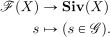
 we have

 , so
, so  is indeed a natural transformation. We already noted last week that
  for
for  if and only if
  , so
, so  is the pullback
![\[\begin{array}{ccc}\mathscr G & \to & \mathbf{1} \\ \downarrow & & \downarrow \\ \mathscr F & \to & \mathbf{Siv}.\!\end{array}\]](https://lovelylittlelemmas.rjprojects.net/wp-content/ql-cache/quicklatex.com-e6b19d602068143e8f20096223b491ec_l3.svg "Rendered by QuickLaTeX.com")
 is any morphism with this property and
  , which together with naturality of
  gives
gives
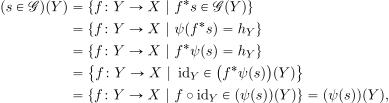
 .
.  with the same target, write
  for the presheaf image of
  . Then a presheaf
  is a sheaf if and only if for every covering
  induces an isomorphism
![\[\operatorname{Hom}(h_U,\mathscr F) \stackrel\sim\to \operatorname{Hom}(S_{\mathscr U},\mathscr F).\]](https://lovelylittlelemmas.rjprojects.net/wp-content/ql-cache/quicklatex.com-a0f70f3439462c4afadb1c770a32f600_l3.svg "Rendered by QuickLaTeX.com")
 of sheaves purely in terms of sieves. This is the notion of a Grothendieck topology that we describe at the end of this post.
 taking
  to its inverse image under
  (I avoid the word ‘pullback’ here to make sure this is truly a subpresheaf and not a presheaf with a monomorphism to
  (it takes values in
  since
since  is a presheaf,
  a subpresheaf, and
  by
by![\[(s \in \mathscr G)(Y) = \left\{f \colon Y \to X\ \big|\ f^*(s) \in \mathscr G(Y)\right\}.\]](https://lovelylittlelemmas.rjprojects.net/wp-content/ql-cache/quicklatex.com-41626fdc17ca16d3b5bb2b8b778f5af4_l3.svg "Rendered by QuickLaTeX.com")
 classifying
  . Note that
  is the maximal sieve
  .
. with
with  is a sieve such that
  , then
  is the maximal sieve
  is covering. Condition 2 says that any sieve containing a covering sieve is covering. In the presence of condition 1, conditions 2 and 3 together are equivalent to the local character found in SGA IV
 , Exp. II, Def. 1.1:
 with
with  the inverse image of
  along
along  is in
is in  , then
  contains a covering sieve
  is covering. Assuming criterion 2, the sieve
  then
then  . Indeed, if
  for some
 ![\[f^*(S \cap T) = f^*S \cap f^*T = h_Y \cap f^*T = f^*T \in J(Y),\]](https://lovelylittlelemmas.rjprojects.net/wp-content/ql-cache/quicklatex.com-93389120c310b342332cdd6a05235e1a_l3.svg "Rendered by QuickLaTeX.com")
 . Axioms 2 and 3 give
  be a pretopology on the (small) category
  as those
  for some covering
  in
in  such that
  for all
  , i.e.
  that are in the given sieve
  is a topology. It is the coarsest topology on
  is a covering sieve.
 with
with  . If
. If  by criterion 3 of Tag
  , because a morphism
  factors through
  if and only if
  factors through
  . Thus,
  , so
, so  with
with  . This means that
  for all
  , i.e.
  for all
  in
in  , i.e.
  for all
  . Thus, if
  denotes
  , then we get
  . But
. But  is any other Grothendieck topology for which each
  induces an isomorphism
![\[\operatorname{Hom}(h_X,\mathscr F) \stackrel\sim\to \operatorname{Hom}(S,\mathscr F).\]](https://lovelylittlelemmas.rjprojects.net/wp-content/ql-cache/quicklatex.com-66512c6741cb329d679d8c390068eee2_l3.svg "Rendered by QuickLaTeX.com")
 ) of which morphisms
  one needs to localise to get
  . In the last two posts, we will generalise this even further to a Lawvere–Tierney topology on an arbitrary topos.
 on a small category (resp. small site) with terminal object
  with the same target
  , define the sieve
  as the sieve on
  that factor through some
  .
. generated by the
  . What does this look like as a subobject of
  has one element, i.e.
  , then
  . In the case where
  for some topological space
  .
.![\[\coprod_{i \in I} h_{U_i} \to h_U\]](https://lovelylittlelemmas.rjprojects.net/wp-content/ql-cache/quicklatex.com-2f71950ccca1f5376f5e2a0248bc4997_l3.svg "Rendered by QuickLaTeX.com")
 . Indeed, an element of
  is a morphism
  , and it comes from some
  if and only if
  : take as index set (the objects of) the slice category
  , which as in the
  . This corresponds to generating an ideal by all its elements.
 be a set of morphisms with common target, and
 ![\[\coprod_{i,j \in I} h_{U_i \underset U\times U_j} \rightrightarrows \coprod_{i \in I} h_{U_i},\]](https://lovelylittlelemmas.rjprojects.net/wp-content/ql-cache/quicklatex.com-5d92cc982b034b2ba4ca16150edea1ce_l3.svg "Rendered by QuickLaTeX.com")
 .
.![\[\begin{array}{ccc}\displaystyle\coprod_{i,j \in I} h_{U_i \underset U\times U_j} & \to & \displaystyle\coprod_{i \in I} h_{U_i} \\ \downarrow & & \downarrow \\ \displaystyle\coprod_{j \in I} h_{U_j} & \to & h_U \end{array}\]](https://lovelylittlelemmas.rjprojects.net/wp-content/ql-cache/quicklatex.com-fda28b9599bd78306714229ee58f10dc_l3.svg "Rendered by QuickLaTeX.com")
 and since fibre products with a fixed set/presheaf of sets commute with coproducts. Then the same goes for the square
![\[\begin{array}{ccc}\displaystyle\coprod_{i,j \in I} h_{U_i \underset U\times U_j} & \to & \displaystyle\coprod_{i \in I} h_{U_i} \\ \downarrow & & \downarrow \\ \displaystyle\coprod_{j \in I} h_{U_j} & \to & S_{\mathscr U} \end{array}\]](https://lovelylittlelemmas.rjprojects.net/wp-content/ql-cache/quicklatex.com-f02566e192b992da176206c6c9de2e8b_l3.svg "Rendered by QuickLaTeX.com")
 is a monomorphism. But
  is an epimorphism (objectwise surjection) by definition, so this square is a pushout as well (in
  of
of  be the diagram
  of the two projections, and let
  be the category of elements of
  , as in
  taking
  to
to  and
and  , taking the morphisms
  in
in  to the projections
  . We claim that
  is given by a morphism
  . Since
  over
over  .
. are two such maps, they factor uniquely through
  . The general result for
  and
and  for
for  (either of the form
  ) follows since elements of the form
  is weakly connected.
 ![\[\operatorname{Hom}(S_{\mathscr U},\mathscr F) \stackrel\sim\to \operatorname{Eq}\left( \prod_{i \in I} \mathscr F(U_i) \rightrightarrows \prod_{i,j\in I} \mathscr F\Big(U_i \underset U\times U_j\Big) \right).\]](https://lovelylittlelemmas.rjprojects.net/wp-content/ql-cache/quicklatex.com-7a26f3f69f1792ce004bc4306ca77643_l3.svg "Rendered by QuickLaTeX.com")
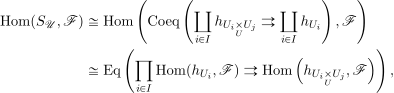
 we should localise (make the inclusion invertible). Next week, we will use this to give a definition of a Grothendieck topology, abstracting and generalising the notion of a site (i.e. Grothendieck pretopology).
 . The Yoneda lemma says that for any presheaf
  and any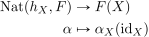
 shows that the Yoneda embedding
![\begin{align*}h \colon \mathscr C &\to [\mathscr C^{\operatorname{op}},\mathbf{Set}] \\X &\mapsto h_X\end{align*}](https://lovelylittlelemmas.rjprojects.net/wp-content/ql-cache/quicklatex.com-a22df4abe70d7634ff3aa4dd0e50eda2_l3.svg "Rendered by QuickLaTeX.com")
 for the comma category whose objects are pairs
  where
where  is a morphism (natural transformation) in
  is a morphism
 ![\[\begin{array}{ccccc}\!\!h_X\!\!\!\!\! & & \!\!\!\!\!\stackrel{h_f}\longrightarrow\!\!\!\!\! & & \!\!\!\!\!h_Y\!\! \\ & \!\!\!\!{\underset{\alpha}{}}\!\!\searrow\!\!\!\! & & \!\!\!\!\swarrow\!\!{\underset{\beta}{}}\!\!\!\! & \\[-.3em] & & F\! & & \end{array}\]](https://lovelylittlelemmas.rjprojects.net/wp-content/ql-cache/quicklatex.com-9769f452029a277a3cf797e8b956fe6a_l3.svg "Rendered by QuickLaTeX.com")
 denotes postcomposition by
  taking
  of pairs
  with
with  with morphisms
  given by morphisms
  . It’s convenient to keep both points of view.
![F \in [\mathscr C^{\operatorname{op}},\mathbf{Set}]](https://lovelylittlelemmas.rjprojects.net/wp-content/ql-cache/quicklatex.com-b67c6133d73d67346560ef1318cabffd_l3.svg "Rendered by QuickLaTeX.com") is naturally a cocone under
is naturally a cocone under ![hU \colon (h \downarrow F) \to [\mathscr C^{\operatorname{op}},\mathbf{Set}]](https://lovelylittlelemmas.rjprojects.net/wp-content/ql-cache/quicklatex.com-6d49f82da104eac175bad0670531b1cb_l3.svg "Rendered by QuickLaTeX.com") via the morphisms
via the morphisms  of representable functors.
 to the constant diagram
 ![(h \downarrow F) \to [\mathscr C^{\operatorname{op}},\mathbf{Set}]](https://lovelylittlelemmas.rjprojects.net/wp-content/ql-cache/quicklatex.com-89df739311fce4fcc226e713c395b40d_l3.svg "Rendered by QuickLaTeX.com") with value
with value  is taken to a natural transformation
  , such that for any morphism
 ![\[\begin{array}{ccc} h_X & \stackrel{\phi_{(X,\alpha)}}\longrightarrow & G \\ \!\!\!\!\!\!\!\!\!{h_f}\downarrow & & |\!| \\ h_Y & \underset{\phi_{(Y,\beta)}}\longrightarrow & G\end{array}\]](https://lovelylittlelemmas.rjprojects.net/wp-content/ql-cache/quicklatex.com-c1ce5be14e235f5edc13d17d78116b91_l3.svg "Rendered by QuickLaTeX.com")
 for all
  such that for every
  .
.
 .
. by
by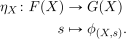
 is the unique natural transformation of cocones
  under
under  . For instance, the universal cocone
  is the natural transformation
  of functors
  be the category of finite nonempty totally ordered sets, with (weakly) monotone increasing functions as morphisms. A simplicial set is a functor
  , and we often think of them as combinatorial models for topological spaces. The representable ones are the standard
 ![\Delta^n = \operatorname{Hom}(-,[n])](https://lovelylittlelemmas.rjprojects.net/wp-content/ql-cache/quicklatex.com-018c22458b6eed01bbaa776fee92b002_l3.svg "Rendered by QuickLaTeX.com") , where
, where ![[n]](https://lovelylittlelemmas.rjprojects.net/wp-content/ql-cache/quicklatex.com-eebb255ca691f41656db4dd939359cfb_l3.svg "Rendered by QuickLaTeX.com") is the totally ordered set
is the totally ordered set  for
for  .
. is a simplicial set, its value at
  of
of  . Then the story above is saying that a simplicial set is the colimit over all its
  .
. is a set of morphisms
  with the property that if
  is any morphism, then
  is in
is in  . Thus, this is like a “right ideal in
  .
. and
and  an object, and
  a functor. Then there is a pullback map
![\[F^* \colon \mathbf{Siv}(F(X)) \to \mathbf{Siv}(X)\]](https://lovelylittlelemmas.rjprojects.net/wp-content/ql-cache/quicklatex.com-33de321b8ace0003470b108803813b47_l3.svg "Rendered by QuickLaTeX.com")
![\[F^*S(U) = \big\{f \colon U \to X\ \big|\ F(f) \in S(F(U))\big\}.\]](https://lovelylittlelemmas.rjprojects.net/wp-content/ql-cache/quicklatex.com-6679e57b6b77bbe674510180efcb8345_l3.svg "Rendered by QuickLaTeX.com")
 and
and  gives a bijection
![\[\mathbf{Siv}(X) \stackrel\sim\to \mathbf{Siv}(X \stackrel{\operatorname{id}}\to X).\]](https://lovelylittlelemmas.rjprojects.net/wp-content/ql-cache/quicklatex.com-feaae142d6f90e68500de7aa6e08f6ed_l3.svg "Rendered by QuickLaTeX.com")
 since
since  and
and  implies
  , so
, so  . For the second statement, given a sieve
  , define the sieve
 ![\[S(U) = \left\{ f \colon U \to X\ \ \left|\ \ \left(\begin{array}{ccccc}\!\!U\!\!\!\!\! & & \!\!\!\!\!\stackrel f\longrightarrow\!\!\!\!\! & & \!\!\!\!\!X\!\! \\ & \!\!\!{\underset{f}{}}\!\!\searrow\!\!\!\! & & \!\!\!\!\swarrow\!\!{\underset{\operatorname{id}}{}}\!\!\!\! & \\[-.3em] & & X.\! & & \end{array}\right) \in T\left(U \stackrel f\to X\right)\right\}\right..\]](https://lovelylittlelemmas.rjprojects.net/wp-content/ql-cache/quicklatex.com-f3584a18c2be13927bf04f95cda81450_l3.svg "Rendered by QuickLaTeX.com")
 .
.  , but we won’t use it as such.
 . We will do so both in the case of presheaves and in the case of sheaves. Note that
  is a singleton, so the diagrams
![\[\mathscr F(U) \to \prod_{i \in I} \mathscr F(U_i) \rightrightarrows \prod_{i,j\in I} \mathscr F\left(U_i \underset U\times U_j\right)\]](https://lovelylittlelemmas.rjprojects.net/wp-content/ql-cache/quicklatex.com-7697202a280875da1923d5bbd809bd65_l3.svg "Rendered by QuickLaTeX.com")
 on a set
  is a function
  to the power set of a point
  . The property
  if
if  , and fails if
  .
. , the implication
  holds. (This terminology is my own. Below, we confusingly prove that these are equivalent to what we described earlier as “right ideals”. This change of orientation arises from the fact that diagrams are drawn in the opposite direction compared to composition of morphisms.)
 holds for all
  holds.
 -truncated sheaf [of spaces] on
  , which is exactly the implication
  .
.![\[\mathscr F(U) \to \prod_{i \in I} \mathscr F(U_i) \rightrightarrows \prod_{i, j \in I} \mathscr F\Big(U_i \underset U\times U_j\Big)\]](https://lovelylittlelemmas.rjprojects.net/wp-content/ql-cache/quicklatex.com-194f989996656f0f895c85d65df1dca1_l3.svg "Rendered by QuickLaTeX.com")
 is empty, then so is
  since
since  for all
  for all
  , so the two arrows agree on
  , and the diagram is an equaliser if and only if
  . Running over all coverings
  in
in